News Archive

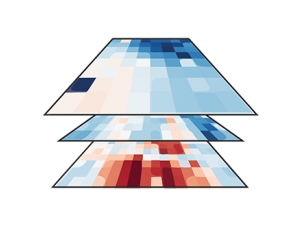
Three layered, abstract heat‑map style grids in shades of blue, red, and beige, stacked to resemble data layers or visualization panels.
Researchers at Georgia Tech are using math, science, and artificial intelligence to better understand how people think, move, and perceive the world.
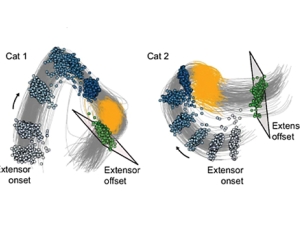
Two side‑by‑side scientific diagrams labeled Cat 1 and Cat 2 showing clusters of colored data points and curved gray lines representing muscle‑activity patterns during movement. Each diagram includes blue, green, and yellow point clusters and marked ‘extensor onset’ and ‘extensor offset’ angles.
Researchers at Georgia Tech are using math, science, and artificial intelligence to better understand how people think, move, and perceive the world.
Three maze-like diagrams labeled ‘water,’ ‘home,’ and ‘explore,’ each showing colored paths representing an animal’s movement through the maze. The paths shift from dark purple at the start to bright yellow at the end, indicating progression over time according to the color scale on the right
Researchers at Georgia Tech are using math, science, and artificial intelligence to better understand how people think, move, and perceive the world.
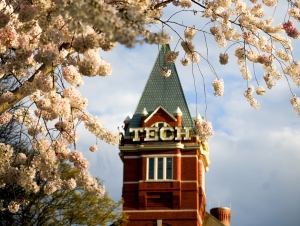
A view of Tech Tower from Crosland Tower. Photo: Georgia Tech
College of Sciences Graduate Programs Earn Strong 2026 U.S. News Rankings
R. Shane Kimbrough speaks in front of room of people during a fireside chat
One day after the historic Artemis II launch, the College of Sciences welcomed more than 150 researchers, students, and community members to its signature Frontiers in Science conference.
Joyce Shi Sim holds a microphone and laser pointer while presenting to room of people
One day after the historic Artemis II launch, the College of Sciences welcomed more than 150 researchers, students, and community members to its signature Frontiers in Science conference.
Professor James Wray holds microphone and points to powerpoint slide during his presentation
One day after the historic Artemis II launch, the College of Sciences welcomed more than 150 researchers, students, and community members to its signature Frontiers in Science conference.
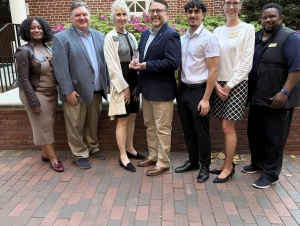
Group photo of five people, including Georgia Tech faculty
One day after the historic Artemis II launch, the College of Sciences welcomed more than 150 researchers, students, and community members to its signature Frontiers in Science conference.
A black banner reading "Frontiers in Science: Advancing Space Exploration." The words are surrounded by dynamic gold sparkles, along with light blue, gold, and white parallelograms.
This year's Frontiers in Science conference will offer an inspiring look at the future of space exploration and life beyond Earth — from satellites and rovers to bold visions for human exploration.
Luis Delgado wearing protective gloves in a lab
Because of Tech Promise, Luis Delgado and Nick Fabrizio were able to dream big and set their sights on Georgia Tech.

Pages