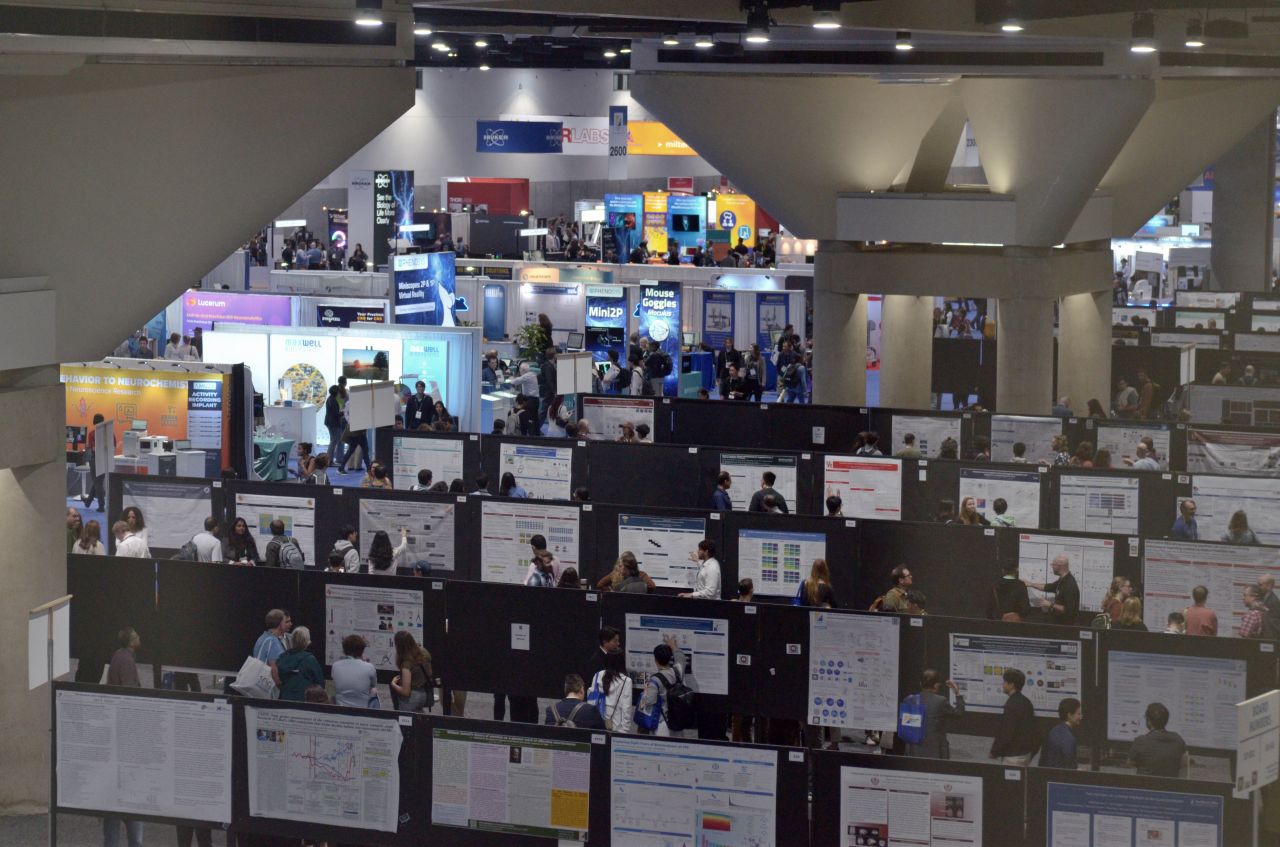
Imagine stepping into a space the size of multiple football fields — only instead of turf and goalposts, it’s filled with science. Every inch is alive with posters, equipment demos, and researchers sharing the latest breakthroughs.
Welcome to the Society for Neuroscience (SfN) Conference, one of the largest scientific gatherings in the world, drawing more than 30,000 attendees to San Diego in November. According to Annabelle Singer, it is the place to be for neuroscientists. “If you want to know what is going on now in neuroscience, it is being talked about at SfN.”
Singer is a McCamish Foundation Early Career Professor in the Wallace H. Coulter Department of Biomedical Engineering (BME) at Georgia Tech and Emory University. A frequent SfN attendee, she describes the meeting as “Dragon Con for neuroscience, with thousands of talks and posters going on simultaneously.”
This year, Georgia Tech didn’t just show up — it made a statement with more than 60 presentations, a major outreach award, and a spotlight press conference.
“Seeing Georgia Tech and INNS represented so strongly at SfN is exciting,” says Chris Rozell, executive director of Tech’s Institute for Neuroscience, Neurotechnology, and Society (INNS). “It reflects the incredible breadth of neuroscience and neurotechnology research happening across our campus and how our work is shaping conversations at the highest level.”
Inside ‘Neuroscience Dragon Con’
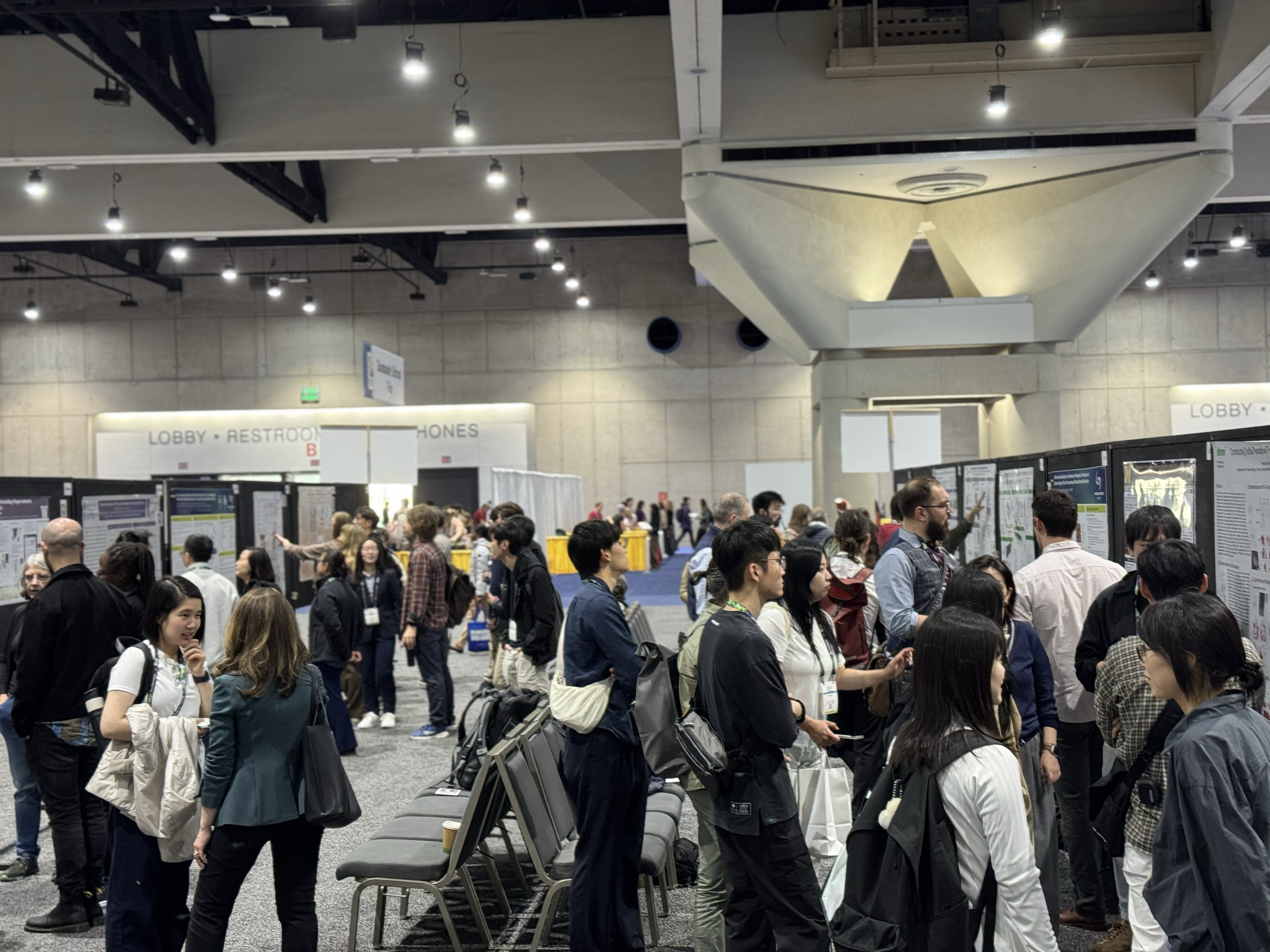
Many conferences center around structured lectures, but at SfN, posters are the heart. You might find a senior researcher presenting groundbreaking findings right next to a first-time attendee sharing early results. This diversity is what makes the experience so valuable, says Singer. “Trainees get to talk directly with the scientist doing the work to get their questions answered, from wondering about future implications to clarifying technical details.”
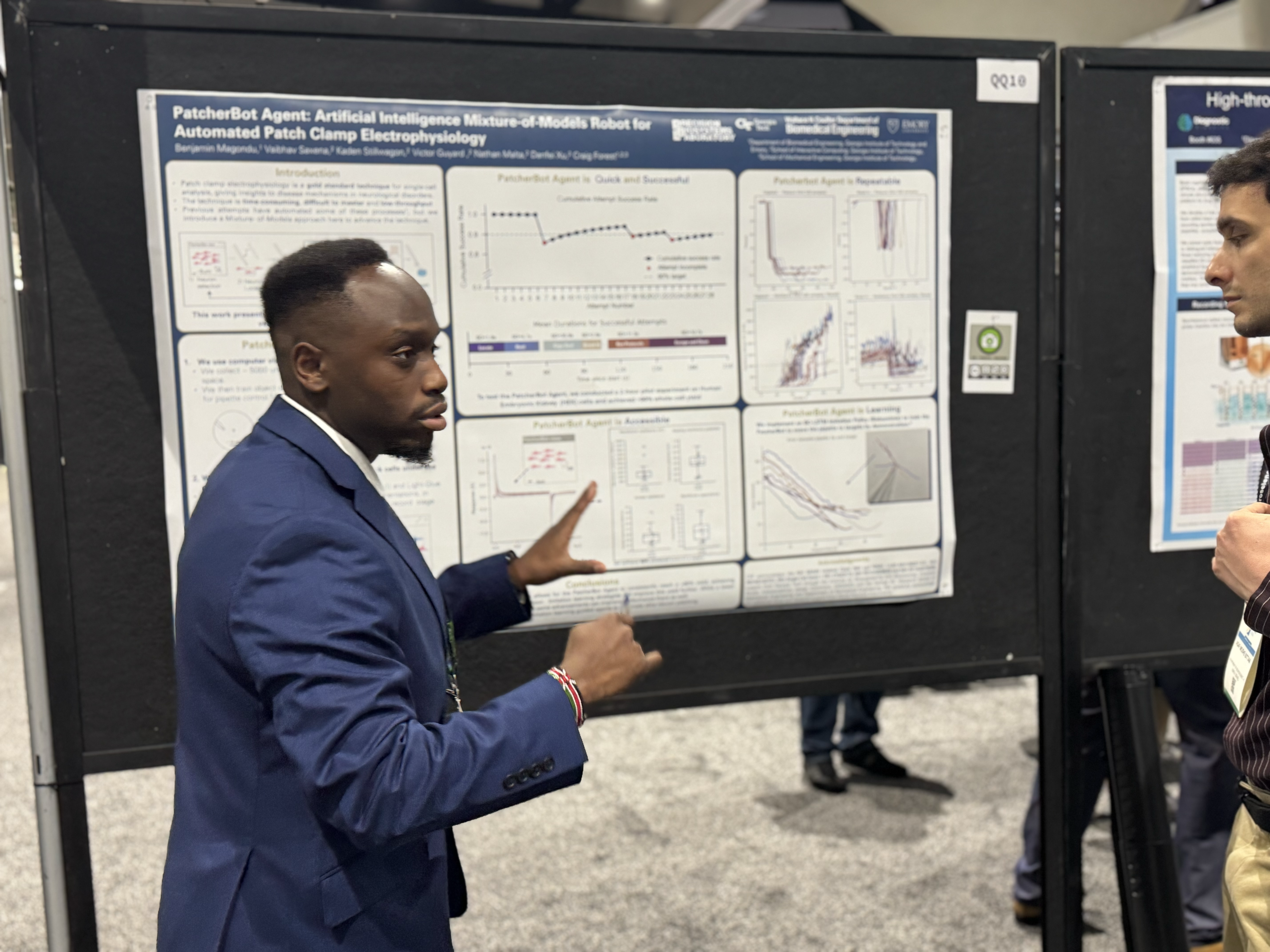
The scale of SfN can feel overwhelming, but for many, that’s part of the excitement. “There are so many different posters from so many different fields. It’s a lot to absorb, but it’s all very interesting,” said Benjamin Magondu, a biomedical engineering Ph.D. student presenting for the first time. “I’ve definitely learned at least 47 things by just walking 10 feet.”
For students like Magondu, the experience is critical, says Biological Sciences Assistant Professor Farzaneh Najafi. “SfN has such a big scope, all the way from molecular to cognitive and computational systems. Especially for those deciding which direction of neuroscience they want to go into, it’s invaluable.”
That breadth also fosters connections across disciplines. “Conferences are usually pretty niche,” noted Tina Franklin, a research scientist in BME. “You have your own field that you’re really good at, but it’s difficult to venture out and find new people who can help you figure out what comes next. This conference brings people from all different fields together with the common interest of neuroscience and brain research.”
Leading the Charge
Georgia Tech’s impact went beyond the conference floor. Ming-fai Fong, an assistant professor in BME, received the prestigious Next Generation Award, one of SfN’s education and outreach awards. The honor recognizes members who make outstanding contributions to public communication and education about neuroscience.
“I’m certainly very grateful to the Society for Neuroscience for recognizing these types of contributions,” says Fong, who was recognized for her work supporting blind and visually impaired youth in Atlanta. “Rewarding outreach efforts reinforces my core belief that scientists and engineers can make an immediate impact on communities we care about through outreach. It’s a great parallel avenue to making a positive impact through research.”
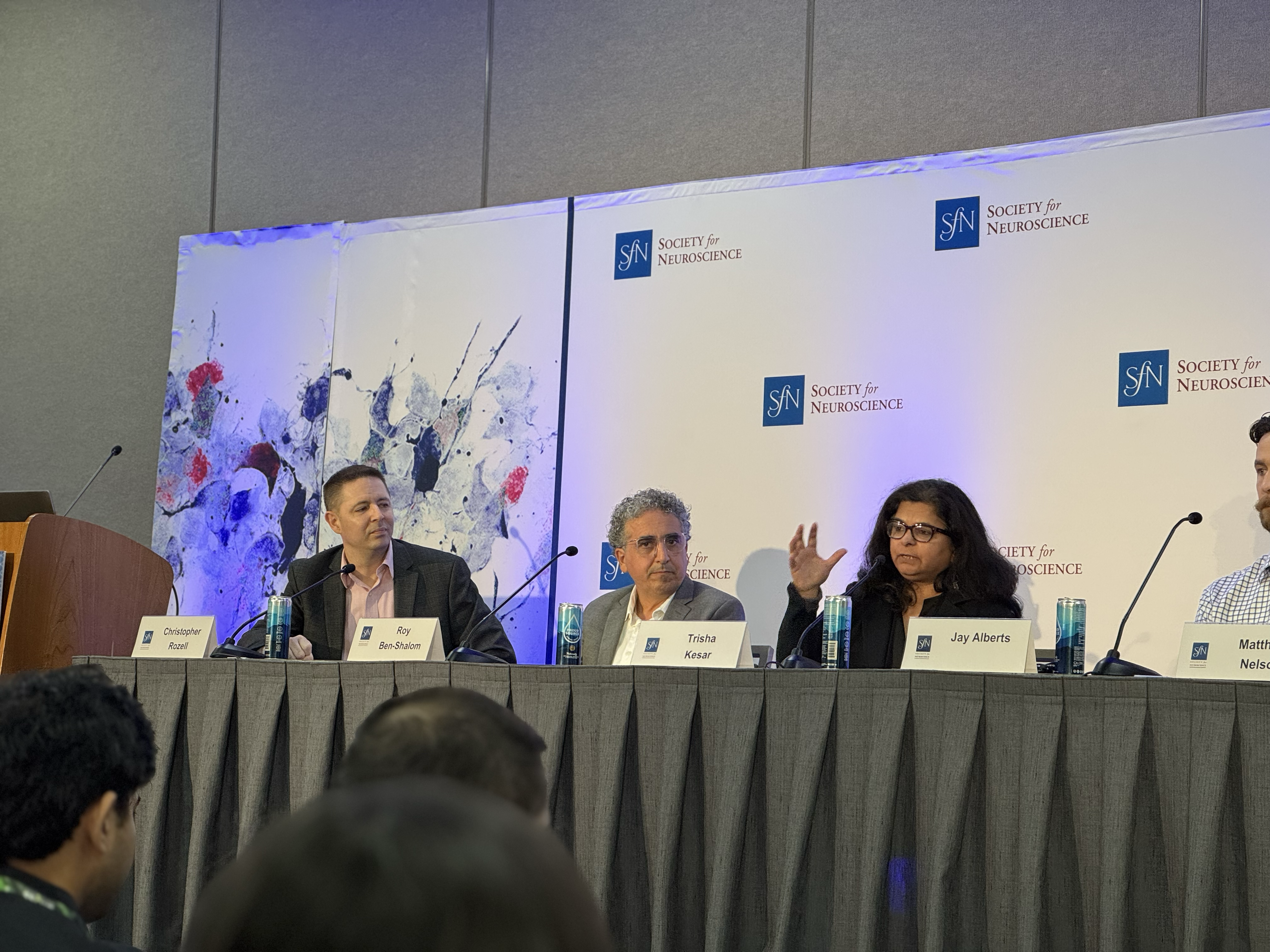
Building on this recognition, Georgia Tech was in the spotlight during one of SfN’s selective press conferences — a session on artificial intelligence in neuroscience moderated by Rozell, who is also the Julian T. Hightower Chair in the School of Electrical and Computer Engineering.
During the SfN press event, Trisha Kesar, an associate professor in BME and adjunct faculty in the School of Biological Sciences, presented her research using AI to improve gait rehabilitation. Her work was among just 40 abstracts selected from more than 10,000 submissions for this honor, and one of five abstracts selected for the AI in neuroscience press conference. The project is a collaboration with Hyeok Kwon, a Georgia Tech computer science alumnus and an assistant professor in BME.
“It’s exciting to see Georgia Tech and Atlanta emerging as hubs for neuroscience innovation,” said Kesar. “Being part of a press conference on AI in neuroscience shows how much our community is contributing to the future of brain research, and how collaboration across institutions can accelerate progress.”
Related Media
1763342998142_viaSfN.jpeg
IMG_6535-2.png
IMG_6838.png
IMG_6748-2.png
For More Information Contact
Writer and media contact:
Audra Davidson
Research Communications Manager
Institute for Neuroscience, Neurotechnology, and Society (INNS)
Presenter Dashboard:
Created by Joshua Preston, Communications Manager, College of Computing
Data collection by Audra Davidson, Hunter Ashcraft